An Evaluation of Comprehensive Floral Graphics Packages: Considerations for Your Projects
When sourcing graphic elements for a design project, the decision often hinges not just on quantity, but on versatility and technical adaptability. A bundle like 150 Floral Vector Elements represents a specific category of digital asset: a substantial collection of botanical artwork delivered in multiple file formats. Understanding what such a package offers, and how it aligns with different workflows, requires a practical look at its components and the contexts in which they are most useful.
What Constitutes a Multi-Format Floral Bundle
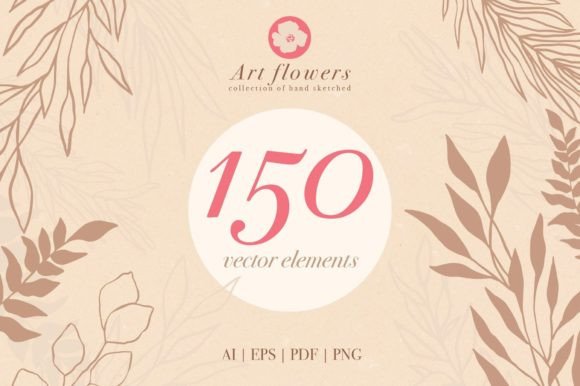
At its core, a collection titled 150 Floral Vector Elements typically provides 150 distinct illustrations of flowers, leaves, wreaths, or similar botanically-inspired motifs. The defining characteristic, however, is the inclusion of several file types. In this case, the assets are provided as AI (Adobe Illustrator native), EPS (Encapsulated PostScript), PDF (Portable Document Format), and PNG (Portable Network Graphics with transparency). Each format serves a different primary function in the design process, and having all four represents a strategic approach to utility.
The AI and EPS files are vector formats. This means the graphics are composed of mathematical paths rather than pixels, allowing them to be scaled to any size without loss of quality or resolution. They are editable in professional vector software like Illustrator or CorelDRAW, permitting changes to color, shape, and composition. The PDF inclusion can often serve as a reliable, universally viewable container for these vector artworks, useful for quick client previews or integration into multi-page layouts. The PNG files are raster images—pre-rendered at a specific resolution with a transparent background. They are immediately usable in virtually any application, from web design in Figma or Canva to simple placement in presentation software like PowerPoint.
Evaluating Strengths and Primary Use Cases
A bundle of this nature offers clear advantages for certain users and scenarios. Its primary strength is workflow flexibility. A graphic designer working on a branding project might use the vector AI files to meticulously customize and integrate floral elements into a logo or pattern, ensuring perfect scalability for print media. Meanwhile, a marketing professional preparing a social media campaign could directly drag and drop the provided PNGs into a template, saving considerable time without needing specialized software.
The volume of 150 elements also provides a broad aesthetic range. Rather than being limited to a few styles, users often find a mix of ornate, simplified, line-art, and filled illustrations within such a collection. This variety supports projects requiring thematic consistency but visual diversity, such as a series of event invitations, a website’s decorative sections, or an educational booklet.
Tradeoffs and Considerations for Potential Limitations
While the multi-format approach is broadly helpful, it introduces considerations. The very breadth of formats means the package is not hyper-specialized for one industry. For instance, a professional print shop working exclusively with high-end vinyl cutting might prefer SVG files specifically optimized for that machinery, which may not be included. Similarly, a web developer focused on modern site performance might seek SVG files for their inline coding capabilities and small file sizes, a factor worth checking in any bundle.
The artistic style is another critical evaluation point. "Floral elements" can range from hyper-realistic botanical drawings to whimsical, cartoon-style blossoms. A collection like 150 Floral Vector Elements will have a specific stylistic direction—often a balanced, commercially-friendly aesthetic—but it may not satisfy a project requiring highly specific period art (like Victorian engraving styles) or ultra-modern, abstract geometry. Assessing the visual samples is therefore essential.
Comparing with Alternative Resource Categories
To make an informed decision, it's useful to consider how such a bundle compares to other common resource paths. Many designers source individual elements from stock vector sites, purchasing only the specific icons needed for a current job. This can be cost-effective for one-off projects but lacks the cohesive library-building and cost-per-element value of a larger bundle. Conversely, subscribing to an ongoing stock service provides endless new items but often at a recurring fee and without the permanent ownership of a downloaded bundle.
Another alternative is custom illustration. For a unique brand identity where no pre-made element will suffice, hiring an illustrator is the correct path, though it involves significantly higher cost, time, and coordination. The 150 Floral Vector Elements product sits between these extremes: it offers a ready-made, owned asset library with enough items to cover many needs without custom creation, but it does not provide exclusive, one-of-a-kind artwork.
Identifying the Best-Fit Situations
This type of product is often a strong fit for several groups. Freelancers and small design studios appreciate the efficiency of having a versatile, on-hand resource for client work across different mediums (print, digital, presentation). Small business owners or content creators, who may not have vector editing skills, benefit immensely from the ready-to-use PNG files for their DIY marketing materials. Educators and non-profit organizers can find the variety useful for creating engaging, visually consistent materials across newsletters, websites, and event flyers.
The decision factor often comes down to project frequency and medium diversity. If you regularly undertake projects that touch both print and digital outputs, and floral motifs are a recurring theme, a comprehensive bundle justifies its value. If your needs are infrequent, highly specialized in one format (like only web SVG), or demand a very narrow artistic style, then a more targeted search might yield a better fit.
When to Consider Other Options
A bundle like 150 Floral Vector Elements may not be the optimal choice in every circumstance. If your work is deeply technical—for example, designing for CNC machining where precise, clean vector paths are paramount—you might need to verify the technical quality and layer structure of the provided AI/EPS files, as not all vector art is created with that level of precision. Similarly, projects demanding absolute stylistic uniqueness, such as a high-end fashion brand’s identity, typically require custom artwork rather than pre-existing elements.
Additionally, for users who only operate in a single ecosystem—like exclusively using Adobe Photoshop for raster-based designs—the vector file portion of the bundle might represent unused value. In that case, a dedicated set of high-resolution, layered PSD floral brushes or stamps could be a more efficient alternative.
Making a Practical and Informed Selection
The key to evaluating any digital asset bundle is to align its specifications with your actual workflow. Scrutinize the format list: do the AI, EPS, PDF, and PNG files match the tools you and your collaborators use? Examine the style previews: does the artistic direction complement your typical projects or client aesthetics? Consider the scope: does 150 elements provide enough variety to serve you across multiple jobs, reducing your future search time?
In practical terms, a well-rounded collection such as 150 Floral Vector Elements serves as a practical toolbox. It won’t replace a specialist tool for a specialist job, nor will it generate an entirely novel artistic vision. However, for a wide range of commercial, educational, and communicative projects that benefit from botanical elegance and visual decoration, it provides a solid, reusable foundation. By owning the files outright, you gain the flexibility to adapt, scale, and implement them as needed, which for many creators balances cost, convenience, and creative control effectively.